
Key takeaways from Webinar | The AI-First Bank: Redefining Digital Banking for the Next Decade
Beyond the AI layer: What does it take to build an AI-first bank?
That distinction shaped the Qorus AI Community webinar, AI First Bank: Redefining Digital Banking for the Next Decade, delivered in partnership with VeriPark.
Moderated by Jan Uriga, Senior Advisor, Qorus, the session brought together Gagan Sethi, Vice President, Product Management at VeriPark; Emel Cuhaci, Chief Business Development Officer at NEOHUB, part of DenizBank Group; Javier Martinez Rodriguez, Director of Analytics & AI at Banco Sabadell; and Funda Cinar, Vice President, Sales at VeriPark.
What does AI-first banking mean for customer experience?
A bank does not become AI-first simply by adding AI to existing processes. It becomes AI-first when intelligence changes how journeys work, how decisions are made and how employees contribute.
Emel Cuhaci put customer expectations at the centre of the discussion. Customers experience speed, relevance and convenience from platforms such as Amazon, Spotify, Instagram and Google, and those experiences influence what they expect from their bank.
But more technology does not automatically create a better experience. New capabilities matter only when they make journeys simpler, more relevant and easier to trust.
Cuhaci's perspective was straightforward: the ambition should be to provide the best customer experience. AI is one means of achieving that, rather than the goal itself.
Javier Martinez Rodriguez reached a similar conclusion from Banco Sabadell's perspective. AI is becoming an important competitive capability, but deploying more models or copilots is not enough. The value comes from embedding intelligence into customer journeys and core processes in ways that help banks respond faster, provide more relevant advice and manage complexity.
How does agentic AI change banking journeys?
Gagan Sethi introduced a framework for understanding the changing role of AI in banking:
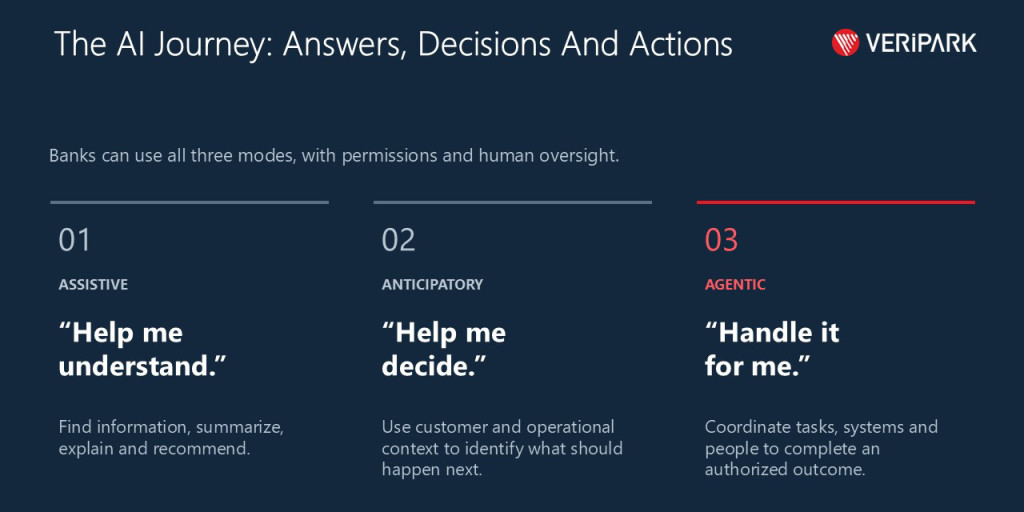
These are not necessarily sequential stages. Banks may use all three depending on the process and their level of maturity.
In lending, for example, assistive AI can assemble an applicant's demographic and financial information. Anticipatory AI can flag exceptions and recommend additional review. Agentic AI can coordinate the broader credit appraisal workflow, including risk assessment, documentation, approvals and disbursement, within the bank's authorization framework.
The important change is that AI begins to reduce the effort between customer intent and an authorized outcome. This also raises a bigger question: will customers always need to navigate banking applications in the same way they do today?
Gagan Sethi, Vice President, Product, VeriPark;
Cuhaci challenged the conventional model by asking why a customer should have to navigate several separate journeys if an intelligent agent already understands the outcome they want.
Martinez Rodriguez described agentic AI as a potential change in customer interaction comparable to the arrival of mobile banking. Today, customers learn how to navigate the bank's interface. Intelligent assistants could increasingly reverse that relationship by understanding the customer's intent.
However, the panel was equally clear about the limits. Identity, consent, security and trust remain fundamental. An AI-first bank does not have to mean a fully autonomous bank.
What does AI-powered personalization require?
Banks already have channels through which they can communicate with customers. The harder problem is deciding what they should say, offer or do for a particular individual.
Cuhaci argued that banks hold significant amounts of behavioral information through transactions, spending patterns and activity within their own services. The opportunity is to convert that information into a deeper understanding of customer needs.
Personalization goes beyond campaigns and product recommendations. It is also about delivering the right financial service at the right moment and in the right context.
Funda Yesim Cinar, Vice President, Sales, VeriPark
Trust remains a prerequisite. Martinez Rodriguez emphasized that customer information should be handled within secure, approved technology environments and the bank's own security framework.
Why do AI pilots fail to scale in banks?
One of the most practical parts of the discussion focused on the distance between a successful experiment and a repeatable enterprise capability.
Cuhaci identified three common barriers:
-
AI treated as an IT project: a pilot remains disconnected from the lending, compliance or service process it is meant to improve.
-
Fragmented data: models struggle to scale when customer information remains spread across legacy systems.
-
Governance added too late: human validation, audit trails and risk controls need to be designed into the solution rather than added afterwards.
Funda Cinar highlighted another recurring problem: initiatives that begin without a clearly defined business outcome. If the organization cannot state what the initiative is expected to improve - whether revenue, productivity, cost, risk or customer experience - demonstrating value later becomes difficult.
Measurement therefore needs to be defined at the start, not after implementation.
What foundations are needed to scale AI in banking?
Gagan Sethi summarized the structural requirements in four areas:
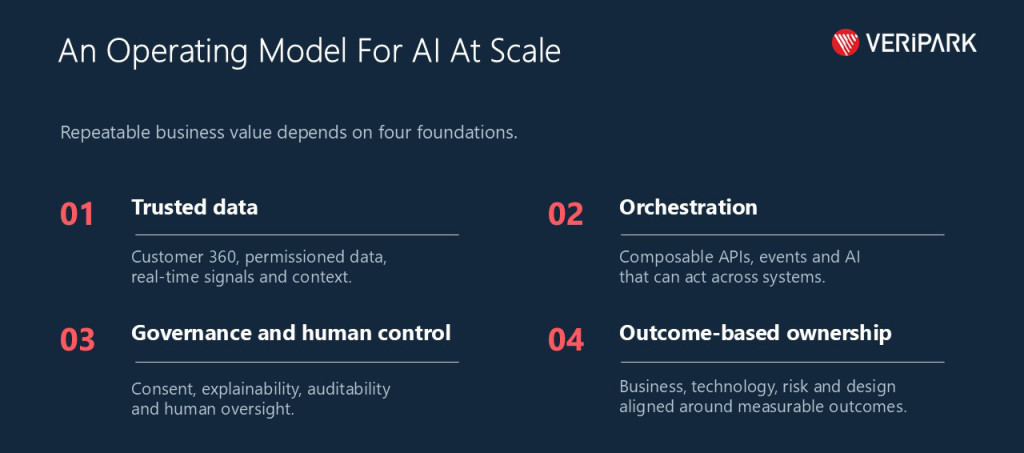
The amount of human intervention should reflect the consequence of the action. A routine customer query does not require the same level of oversight as a significant credit or risk decision.
The objective is therefore not to choose between automation and manual control. It is to design the appropriate level of control for each process.
Should banks build, buy or partner for AI?
There is no single sourcing model.
Banks may buy standardized capabilities, develop others internally or co-build with specialist technology partners. The right mix depends on the business requirement, the institution's existing capabilities, regulation and the scale of the desired outcome.
Martinez Rodriguez summarized the scaling challenge around three areas: measurable outcomes, reusable capabilities and an evolving operating model.
Shared data, APIs, security, knowledge and governance can prevent each new AI use case from becoming a separate technology project. Clear ownership and multidisciplinary teams then help turn those foundations into repeatable business value.
What should banking leaders do next?
The discussion pointed to five practical priorities:
| 1. Choose a real problem. Start with the customer or business issue AI is expected to solve. |
| 2. Define the outcome before delivery begins. Decide how success will be measured in revenue, cost, risk, service or customer experience. |
| 3. Redesign the workflow. Avoid simply adding an AI layer to an unchanged process. |
| 4. Build reusable foundations. Trusted data, orchestration, governance, security and scalable infrastructure should support multiple use cases. |
| 5. Change how the organization works. Clear ownership, multidisciplinary teams and appropriate human judgement matter as much as the technology itself. |
Uriga closed with a practical challenge: choose one journey or decision where AI could make a meaningful difference, define the desired outcome, and identify what needs to change across data, processes, governance and people.
That may be the clearest definition of an AI-first bank: an institution that can repeatedly use intelligence to produce better customer outcomes and stronger business performance without weakening trust.
TL;DR: What banking leaders need to know
-
What is an AI-first bank?
An AI-first bank embeds AI into customer journeys, decisions and workflows rather than treating it as a standalone technology layer. The aim is to improve customer and business outcomes at scale while maintaining governance, trust and appropriate human oversight.
-
What is agentic AI in banking?
Agentic AI coordinates authorized actions across systems, tasks and people to help complete a defined banking outcome. It goes beyond providing information or recommendations by helping orchestrate execution within agreed controls.
-
Why do AI pilots fail to scale in banks?
Common barriers include fragmented data, poor integration with business workflows, governance introduced too late and unclear business outcomes.
-
What does a bank need to scale AI?
The panel identified four foundations: trusted data, orchestration, governance and human control, and outcome-based ownership.
-
Does AI-first banking mean fully autonomous banking?
No. The appropriate level of human oversight depends on the decision and its consequences. High-stakes areas such as credit, risk, security and customer vulnerability may require significantly more human control than routine interactions.