

Simplifying treasury management
How banks can eliminate fragmented processes and onboard corporate clients faster
Corporate clients rely on their banks for far more than just accounts and credit. Treasury services such as payments, collections, fraud prevention and reporting are the operational backbone of how mid-market and large companies move money and manage risk.
Treasury Management onboarding is the process banks use to price, approve, document, configure, and activate those services. It requires coordination across pricing committees, legal teams, operations, compliance, and relationship managers, often long before any revenue is realized.
And yet, for many banks, this first step is still the slowest, most error-prone stage in the entire commercial banking lifecycle.
In a world where corporate clients expect speed, visibility, and predictability, slow and fragmented treasury onboarding is no longer just an inconvenience. It is a competitive weakness for banks.
The hidden cost of slow treasury onboarding
Treasury onboarding typically involves dozens of steps: pricing approvals, agreement generation, service setup, configuration, testing, training, and ongoing maintenance often across multiple systems and teams.
At many banks, the process still runs on spreadsheets, email threads, PDFs, and manual routing. This creates friction that affects everyone involved:
-
Delayed activation means delayed revenue: Treasury services generate fee income only after activation. When onboarding takes weeks instead of days, revenue silently slips.
-
Corporates lose confidence: When clients can’t see progress or understand the next step, they begin to question the bank’s operational maturity.
-
Small errors create big bottlenecks: A single incorrect field in a PDF agreement can trigger days of back-and-forth revisions.
-
Handoffs become points of failure: Treasury Sales, Implementation, Operations, and Training often work in different tools none of which reflect the full picture.
The result? A slow, reactive experience that feels out of sync with the speed at which modern businesses operate.
Why legacy processes persist and why they no longer work
Treasury onboarding only seems simple from the outside. Behind the scenes, banks juggle:
-
pricing structures with exceptions
-
service configurations that differ by industry and company size
-
approval rules that vary by limits, entitlements, and risk
-
documentation requirements that change by product
-
multiple teams participating at different points
Without a centralized workflow, each step is recreated manually, often by copying, pasting, editing, and resending information through spreadsheets and emails.
This worked when corporate clients accepted longer timelines. It doesn’t work anymore. Today’s corporate treasurers operate in a world defined by:
-
tighter cash-flow cycles
-
real-time business expectations
-
digital procurement processes
-
multinational operations
-
rising internal pressures to improve treasury efficiency
They expect the same from their banking partners.
What corporate clients actually want
Banks often assume corporate clients evaluate treasury services based on advanced features alone. But during onboarding, clients prioritize something much simpler:
-
Predictability: Clients want to know exactly what’s happening, what’s coming next, and when services will go live.
-
Clarity: They want forms that are correct the first time —not versions that bounce back with corrections.
-
Fewer touchpoints: One consolidated experience, not five different systems and a dozen email threads.
-
Speed: A process that takes days or minutes, not weeks.
It’s less about technology sophistication and more about operational confidence:
“Your bank knows how to onboard us without delays.”
How a unified treasury workflow changes everything
Instead of stitching together spreadsheets, emails, and disconnected tools, banks are adopting a unified Treasury Management workflow that connects pricing, onboarding, implementation, and servicing in a single, trackable process.
Here’s what that shift looks like.
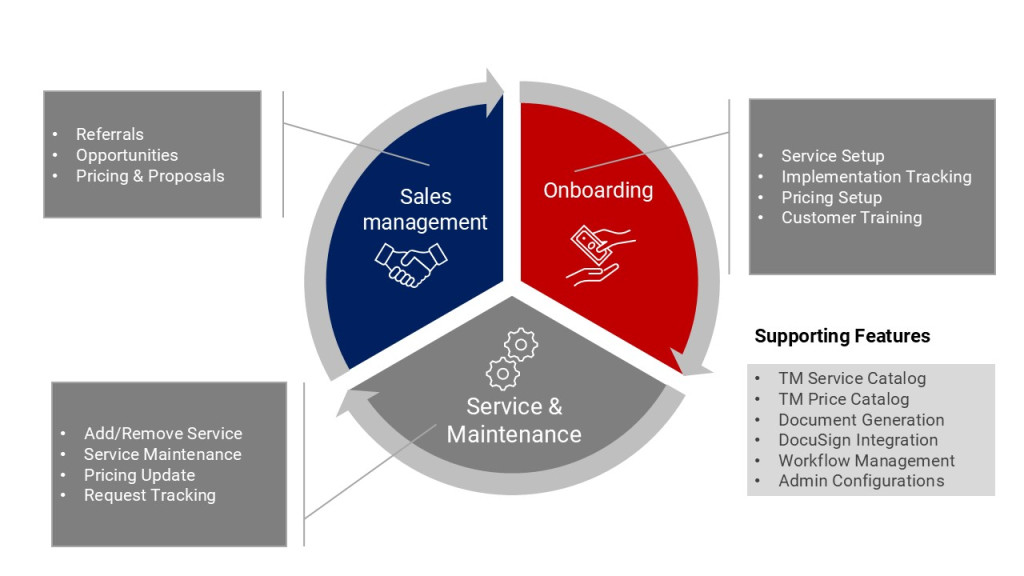
1. Start strong: pricing and proposals without the spreadsheet chaos
The onboarding journey doesn’t begin with implementation. It begins with pricing and proposals. And this is where many treasury teams lose time fast: spreadsheets get versioned, approvals get buried in email, and proposals take longer than they should.
With a unified workflow, banks can set pricing, manage exceptions, trigger approvals, and generate proposals in one structured flow so teams move faster and clients get answers sooner.
2. Faster onboarding powered by automation
Modern onboarding replaces manual document creation and data re-entry with automation:
-
digital forms generated directly from captured data
-
DocuSign integration for seamless execution
-
validations that eliminate common errors
-
automated task creation for implementation teams
-
SLA tracking that sets clear expectations
-
guided workflows for different TM services (ACH, RDC, wires, positive pay, etc.)
The result is a predictable, structured onboarding journey that doesn’t rely on someone remembering to send the next email.
3. Maintenance that doesn’t slow the bank down
Corporate clients frequently request:
-
limit increases or temporary limits
-
adding or removing treasury services
-
pricing modifications
-
documentation updates
With a unified system, these requests follow defined workflows with:
-
built-in routing
-
automated approvals
-
documentation generation
-
integration with document management systems
-
full audit trails
Banks can handle complexity at scale without increasing operational burden.
3 outcomes banks should aim for when improving treasury onboarding
Modernizing treasury onboarding is not about making the process flashy. It’s about improving outcomes that matter to the bank and its clients.
1. Faster time-to-activation, enabling treasury services to generate revenue sooner. When the workflow is structured, cycle time shrinks. Quicker activation means:
-
faster revenue recognition
-
shorter implementation cycles
-
improved cash-flow predictability for clients
2. Reduced operational friction with fewer errors, less rework, and clearer accountability. Banks that modernize treasury management processes often discover that bottlenecks disappear simply because the workflow is no longer scattered. Removing spreadsheets and ad-hoc emails means:
-
fewer errors
-
less rework
-
clearer team accountability
-
better use of staff time
3. Stronger corporate client experience with predictable timelines and fewer handoffs. Corporate banking is built on trust. A smooth onboarding journey signals: “We’re organized. We’re capable. We’re ready for your business.”
Banks that simplify treasury management onboarding differentiate themselves in a competitive market where corporates have more choices —and higher expectations— than ever before.
Where banks can start
Transforming treasury onboarding doesn’t require replacing the treasury management core. The biggest wins come from fixing the layers around it. Small improvements quickly compound into meaningful gains.
Banks can begin by:
-
mapping their current onboarding process
-
identifying manual steps that create rework
-
digitizing agreements and approval flows
-
defining SLAs per service
-
consolidating workflows into one system
-
reducing reliance on spreadsheets and email threads
| In summary: Banks can significantly improve treasury onboarding by replacing spreadsheet- and email-based coordination with a unified workflow that connects pricing, onboarding, implementation, and ongoing service management. |
See the difference a unified treasury management workflow can make
If your treasury management onboarding process still relies on email chains, PDF forms, or spreadsheet trackers, you’re not alone, and you’re not stuck.
A unified treasury workflow can help you onboard corporate clients faster, reduce internal friction, and deliver a client experience that matches the pace of modern business.
Book a 30–40 minute demo to explore how a streamlined treasury management workflow can accelerate activation and strengthen your corporate banking relationships.
VeriPark's AI agents and solutions are powered by
